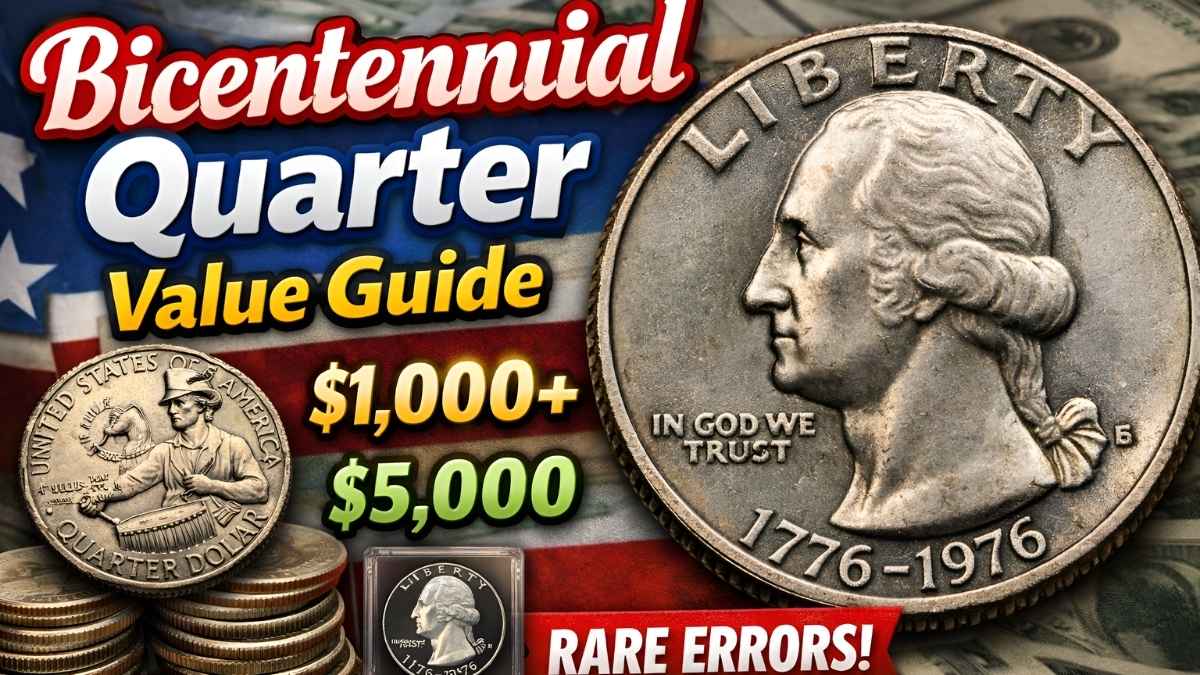
Bicentennial Quarter Value Guide: In 1976, the United States celebrated its 200th anniversary of independence. To honor this milestone, the U.S. Mint released a special commemorative quarter. Unlike the standard Washington quarter, the Bicentennial edition featured a unique reverse design created by Jack L. Ahr. It depicted a colonial drummer with a torch surrounded by thirteen stars, symbolizing the original colonies. The obverse still carried George Washington’s portrait, but the date was marked as 1776–1976, making it instantly recognizable.
This coin was not just a circulating piece of currency. It was a symbol of national pride and a reminder of America’s journey from revolution to modern democracy. Collectors and everyday citizens alike were drawn to its distinctive design, and millions were saved as keepsakes.
How Many Bicentennial Quarters Were Minted
The Mint produced an enormous number of Bicentennial quarters, with over 1.6 billion struck across Philadelphia, Denver, and San Francisco. This makes it one of the most widely distributed commemorative coins in U.S. history. Because of this massive mintage, most Bicentennial quarters are common and worth only their face value in circulation. However, certain varieties, conditions, and errors can make them far more valuable to collectors.
Types of Bicentennial Quarters
There are two main types of Bicentennial quarters:
- Clad Quarters: These were the standard circulation coins made of copper and nickel. They weigh 5.67 grams and are the most common.
- Silver Quarters: Special collector versions were struck in 40 percent silver. These were sold in proof and uncirculated sets and weigh slightly more at 5.75 grams. Their silver content alone gives them intrinsic value beyond face value.
Values of Bicentennial Quarters
The value of a Bicentennial quarter depends heavily on its type, condition, and rarity. Here is a general breakdown:
- Circulated Clad Quarters: Usually worth only 25 cents.
- Uncirculated Clad Quarters: Can range from $1 to $5 depending on grade.
- Proof Clad Quarters: Often sell for $5 to $10.
- Silver Proof Quarters: Typically valued between $8 and $15, though high-grade examples can fetch more.
- Mint State Clad Quarters: Some can reach $20 or more if graded MS65 or higher.
- Error Coins: These are the real treasures. Depending on the error, values can climb into the hundreds or even thousands.
Rare Varieties and Errors
While most Bicentennial quarters are common, certain rare varieties and minting mistakes make them highly collectible. Some examples include:
- Double Die Errors: Coins showing doubled lettering or details can be worth hundreds.
- Off-Center Strikes: If the design is noticeably misaligned, values increase significantly.
- Clipped Planchets: Coins missing a portion of the metal due to a minting error are prized by collectors.
- Proof Errors: Silver proof coins with mistakes are especially rare and valuable.
Why Collectors Value Bicentennial Quarters
Collectors are drawn to Bicentennial quarters for several reasons. First, they represent a historic celebration of America’s independence. Second, their unique design sets them apart from other Washington quarters. Third, the sheer variety of mint marks, finishes, and errors provides endless opportunities for building a diverse collection. Finally, they are affordable entry points for new collectors, while rare examples offer serious investment potential.
Tips for Identifying Valuable Bicentennial Quarters
If you have Bicentennial quarters, here are some tips to determine if they might be worth more than face value:
- Check the Mint Mark: Coins from San Francisco with an “S” mint mark are often silver proofs.
- Look for Errors: Examine the coin carefully under magnification for doubling, off-center strikes, or other anomalies.
- Assess Condition: Coins with minimal wear and strong luster are worth more.
- Consider Grading: Professional grading services can authenticate and assign a grade, which often increases value.
The Market for Bicentennial Quarters
The coin market fluctuates, but Bicentennial quarters remain popular among collectors. Common clad versions are easy to find, but silver proofs and error coins continue to attract strong demand. Online auctions, coin shows, and dealer shops frequently feature these coins, and prices vary depending on rarity and condition. While most Bicentennial quarters are not rare, the thrill of finding a valuable variety keeps collectors searching.
Investment Potential
Although Bicentennial quarters are not generally considered high-value investments, certain rare examples can appreciate over time. Silver proof coins benefit from the intrinsic value of silver, while error coins are unique and often command premium prices. For collectors who enjoy history and design, these coins offer both sentimental and financial rewards.

Conclusion
The Bicentennial quarter is more than just a piece of currency. It is a symbol of America’s 200th birthday, a reminder of the nation’s heritage, and a beloved collectible. While most are worth only face value, rare varieties and pristine examples can be surprisingly valuable. Whether you are a seasoned collector or someone who saved a few coins from circulation, the Bicentennial quarter remains a fascinating piece of numismatic history.